Do you want to grow as a disciple of Christ but feel unsure how to start? Maybe you have ideas for growth, yet life is hectic. It can be hard to add new routines to an already full day.
How can we cultivate rhythms for spiritual growth that actually work when life is busy, as it is for so many of us?
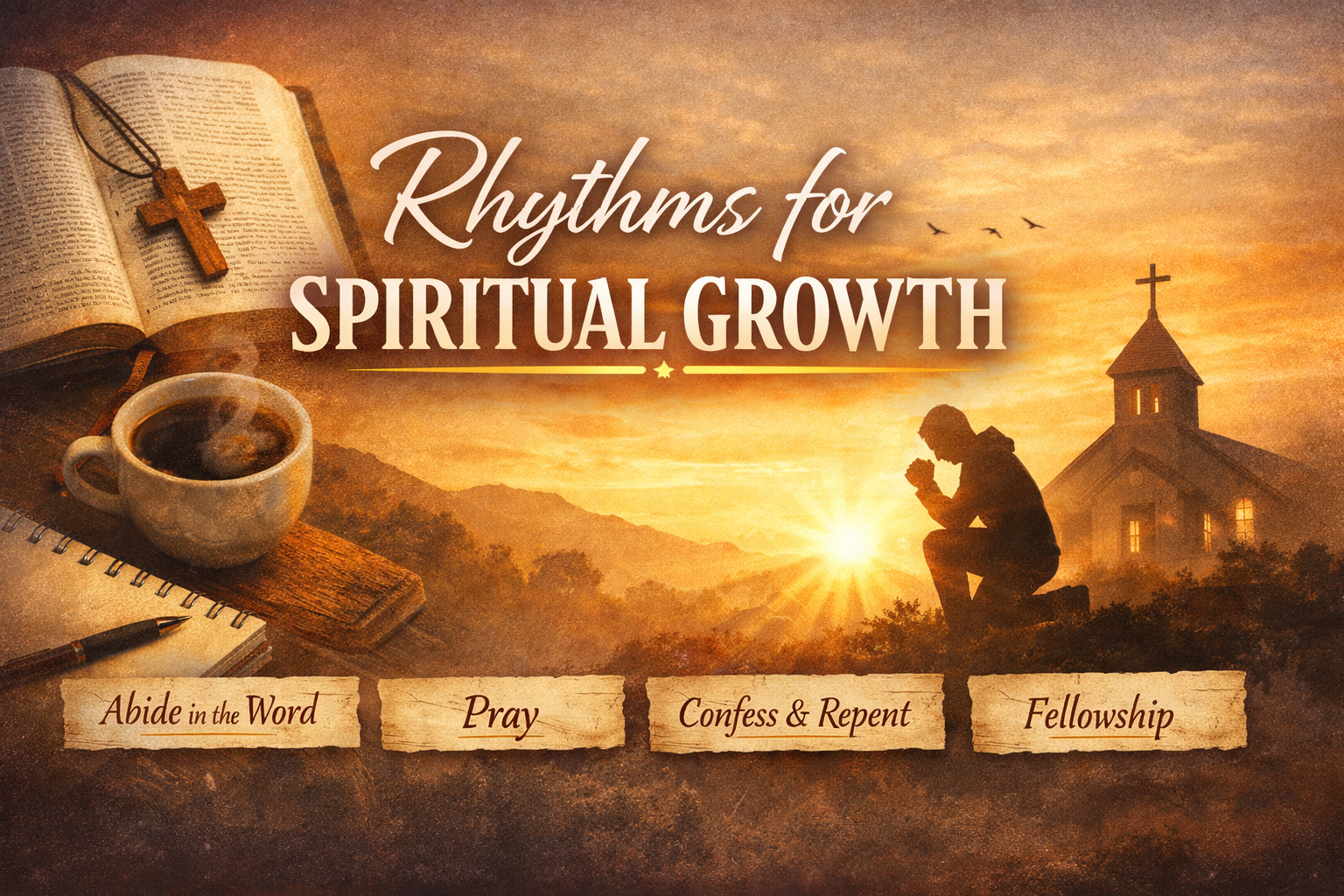
In this post, we’ll explore some of the most crucial rhythms for spiritual growth. The following is not an exhaustive list, but I hope it will be a solid foundation for pursuing maturity in Christ.
1. Abide in God’s Word
John 8:31–32 reads:
“So Jesus said to the Jews who had believed him, ‘If you abide in my word, you are truly my disciples, and you will know the truth, and the truth will set you free.’”
God’s Word is the instrument for sanctifying believers (Jn 17:17). Abiding in God’s Word leads us to know and live the truth.
Thus, it is crucial to regularly spend time in God’s Word.
Yet, there are different ways to spend time in God’s Word. Here are several crucial ways we interact with God’s Word:
- Read: Knowing God’s Word—what it says and doesn’t say—requires reading broadly through Scripture (Deut 17:19; Matt 28:20).
- Study: This is reading more deeply and carefully to understand the meaning of a text of Scripture (Neh 8:8; Acts 17:11).
- Memorize: Committing Scripture to memory allows us to take God’s Word with us wherever we are, keeping us from wandering from it (Ps 119:10–11).
- Meditate: This means filling our minds with God’s Word such that it reaches deeply into our innermost person. It involves reflecting on and delighting in God’s Word throughout the day (Josh 1:8; Ps 1:2–3).
- Apply: A true response of faith involves applying God’s Word to our lives (Jn 14:15; Jas 1:22).
You might look at this list and feel intimidated. You may desire to spend more time in the Word, and yet, you simply cannot find the time. If this is you, take heart—God’s grace covers our shortcomings, and He delights in even our small and imperfect efforts. Remember, spiritual growth is not about perfection, but about taking faithful steps forward, no matter how small.
Focus on Meditation
If you could make only one change to your Bible intake, I would start with meditation. This would have the greatest impact because meditating on Scripture calibrates us to see the world in light of the truth. On top of that, Scripture meditation can fit around any schedule!
Here is a simple framework for meditating on Scripture:
- Pick a passage – Choose a small portion of Scripture that you want to grab hold of.
- Sit with it – Spend time with the passage. Think about it. Reflect on the implications of this truth. If you have time, do not rush this step.
- Take it with you – Try memorizing the passage. Or, simply return to it throughout the day to remind yourself of the truth.
Reflecting on the passage throughout the day is the key to meditation’s power. It also allows meditation to fit into any schedule. For example, you might choose a verse in the morning and repeat it to yourself during your commute, letting the words shape your thoughts as you walk, drive, or ride the bus. Or, while folding laundry or preparing meals, you can recall the passage and ask God to show you how it applies in different areas of your life. Even ordinary moments offer opportunities for meditation, helping God’s truth become part of your daily rhythms.
2. Pray
Jesus introduces his teaching about prayer by saying, “When you pray…” (Matt 6:5, 7; Lk 11:2). He does not say if, but when. The implication is that he expects his disciples to pray.
Most Christians probably recognize that they should pray. And yet, in the busyness of life, prayer is often pushed to the back burner. Even mature believers sometimes struggle to maintain a regular prayer life, finding their desire outpaced by distractions or fatigue. If you have faced this, be encouraged—this struggle is common and normal. Growth in prayer comes with perseverance and grace, not perfection.
Here are a few practical suggestions for integrating prayer into your daily rhythms:
- Use a framework: One helpful framework uses the acronym “ACTS” (Adoration, Confession, Thanksgiving, and Supplication) to guide prayer. Or, you could use “The Lord’s Prayer” (Matt 6:9–13) as a framework. Using a framework can help keep the prayer balanced and focused.
- Pray Scripture: Praying the Psalms can be particularly effective. They are essentially a Spirit-inspired prayer book. This practice shapes our prayers in a biblical direction. You can directly pray a portion of Scripture or let Scripture guide your thoughts and language as you pray for the concerns of your heart. You could even combine this with meditation by praying through a verse you are meditating on.
- Be both scheduled and spontaneous: Without scheduled prayer, other things may crowd it out. Still, praying without ceasing (1 Thess 5:17) calls for a prayerful attitude at all times, scheduled or not. Silent prayer throughout the day weaves prayer into a busy life.
3. Continue to Confess and Repent
1 John 1:9 tells us:
“If we confess our sins, he is faithful and just to forgive us our sins and to cleanse us from all unrighteousness.”
Discipleship is a lifelong process that requires dying to oneself daily to follow Christ (Lk 9:23). This means we must continue to come to the cross. And so, the Christian life is one of ongoing confession and repentance.
Thus, continuing to confess our sins is one way that God sanctifies us.
4. Gather with Believers
Hebrews 10:24–25 reads,
“And let us consider how to stir up one another to love and good works, not neglecting to meet together, as is the habit of some, but encouraging one another, and all the more as you see the Day drawing near.”
This exhortation highlights the importance of regularly gathering with believers, primarily within local church settings. Scripture teaches that God gifts the church to build each other up in love. Each person is uniquely equipped for this purpose.
If you don’t have a church, seek one out and pray that the Lord would direct you to a place where you can grow in Christian community. Look for a church that is committed to biblical teaching, where the gospel is faithfully taught, and Scripture is central.
Other Disciplines
These are not the only disciplines that Scripture prescribes for training in godliness. We might add to this list disciplines like worship, evangelism, and stewardship.
This is why abiding in God’s Word leads this list. God uses it to guide us to other disciplines. Scripture tells us who God is and how to respond to him. We can trust the Spirit to use the Word to move us toward faithful obedience.
Conclusion
In conclusion:
God uses His Word, prayer, confession, and gathering with other believers to grow his people to greater maturity in Christ.
This is not an exhaustive list, but it provides a firm foundation for spiritual growth. While we give our efforts to planting and watering, God ultimately gives the growth (1 Cor 3:6–8). All glory be to Him!

How to Maximize Your Bible Reading
God’s Word is the primary means of grace God ordinarily uses to bring remarkable life…

How to Build a Bible Reading Habit
God’s Word is the main way he shepherds his people. And so, Bible reading is…
The Life-Changing Power of Scripture
We live in a uniquely loud time period. So many voices vie for our attention,…
Pingback: Barriers to Growth: Why Many Christians Feel Stuck - deepeningdiscipleship.com